
Free pickup from ACS lockers or store

Free delivery for orders over €85 per shop


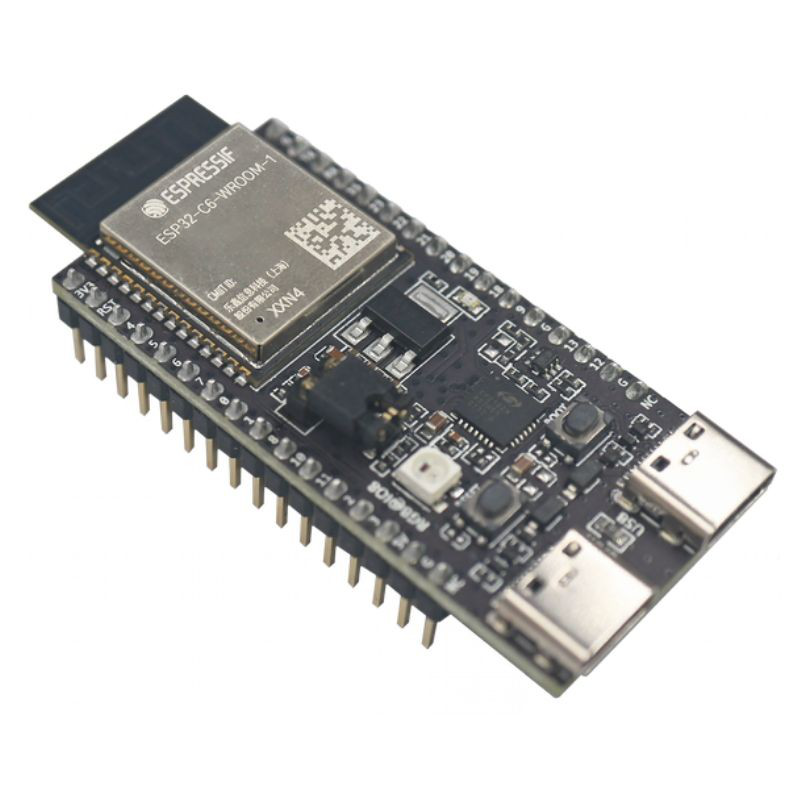

The ESP32-C6-DevKitC-1 is a premium development board manufactured by Espressif Systems, powered by an advanced 32-bit RISC-V processor. It is the ultimate solution for modern IoT and Smart Home ecosystems, integrating next-generation wireless protocols: Wi-Fi 6, Bluetooth 5 (BLE), and IEEE 802.15.4 (Zigbee 3.0 & Thread). It features 8MB of SPI Flash and is easily programmable via the Arduino IDE or ESP-IDF. Caution: The operating and logic voltage (logic level) on the GPIO pins is strictly 3.3V.
The official ESP32-C6-DevKitC-1 development board by Espressif Systems brings the power of Wi-Fi 6 and Mesh networking straight to your workbench. Equipped with the robust ESP32-C6-WROOM-1-N8 module, which houses a power-efficient 32-bit RISC-V processor, it delivers unmatched stability and speed. It is the definitive choice for Engineers and Makers looking to build low-power Smart Home nodes (e.g., for Home Assistant) with state-of-the-art wireless capabilities.
Not directly. As with all ESP microcontrollers, the logic voltage on the pins is strictly 3.3V. Connecting a 5V signal directly to a GPIO will permanently damage the chip. To safely communicate with 5V logic devices, you must use a Level Shifter.
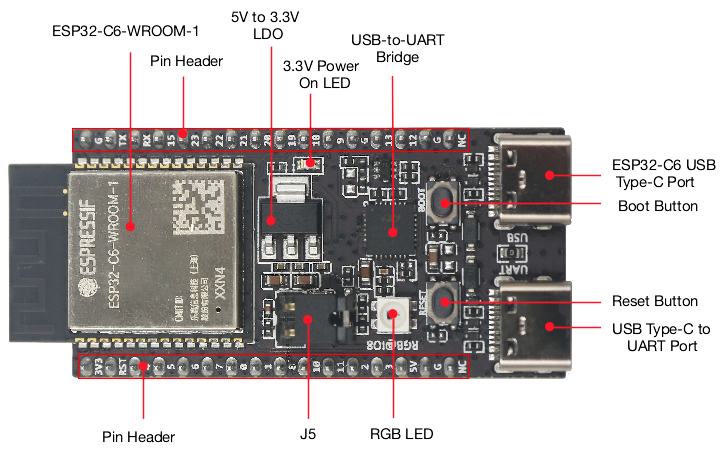
Depending on the specific board revision, the onboard Communication Chip handles the USB interface. On most modern operating systems (Windows 10/11, macOS, Linux), the required drivers install automatically. If not, you can download the standard drivers for the CH34x or CP210x series, depending on the USB-to-UART bridge implemented on the board.
| Microcontroller / Module | ESP32-C6-WROOM-1-N8 (RISC-V 32-bit single-core) |
|---|---|
| Logic Level Voltage | 3.3V (Range: 3.0 - 3.6V) |
| Input Voltage (VIN) | 5V (via USB port) |
| Memory | 8 MB SPI Flash / 512 KB HP SRAM / 320 KB ROM |
| Wi-Fi Standard | Wi-Fi 6 (802.11b/g/n/ax) |
| Bluetooth / IoT | Bluetooth 5 (BLE) / Zigbee 3.0 / Thread (802.15.4) |
Learn how to easily get started with your ESP32
Guide: ESP32 on Arduino IDEAs an official Espressif DevKitC, this board typically comes factory-assembled with the pin headers pre-soldered, making it instantly breadboard-friendly right out of the box. It is shipped in protective anti-static packaging.


