
Free pickup from ACS lockers or store

Free delivery for orders over €85 per shop


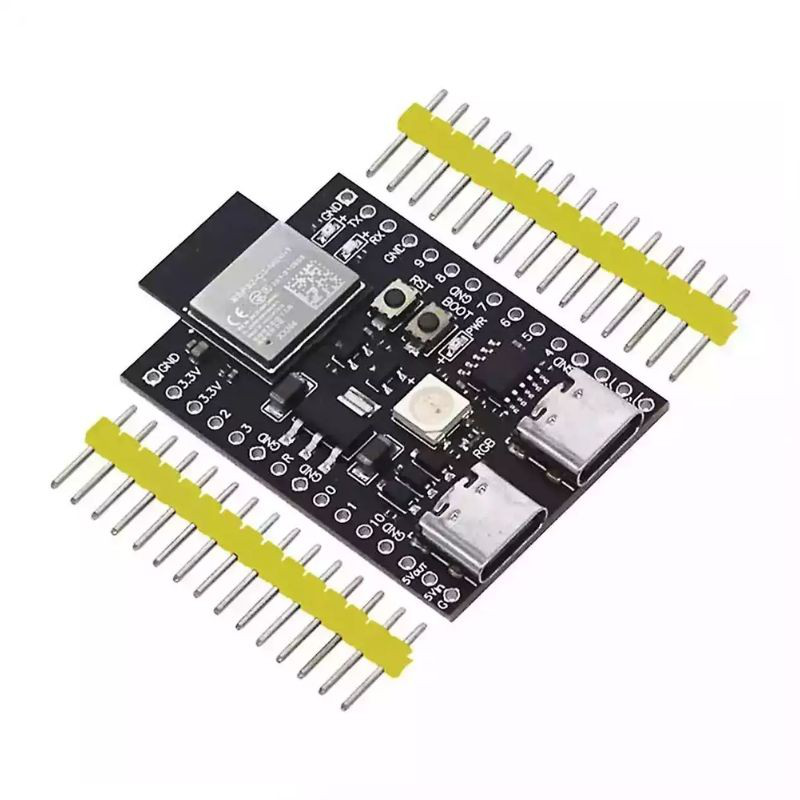

The ESP32-C3 Mini Dual Type-C (OEM) is an ultra-compact IoT development board powered by a highly efficient 32-bit RISC-V single-core processor. It delivers complete wireless connectivity, supporting Wi-Fi 4 (802.11 b/g/n) and Bluetooth LE 5.0 / Mesh. It stands out with its dual USB Type-C ports (for UART and USB/JTAG) and is incredibly easy to program via the Arduino IDE or MicroPython. Caution: The operating and logic voltage (logic level) on the GPIO pins is strictly 3.3V.
The compatible ESP32-C3 Mini (OEM) board perfectly marries a tiny footprint with the robust performance of the RISC-V architecture. Designed around the reliable ESP32-C3-MINI-1 module, it provides the ideal balance between processing power (160 MHz) and low energy consumption. It is the perfect choice for Makers and Engineers looking to build compact, smart devices, wireless sensor nodes, or custom hardware for their Smart Home and Home Assistant ecosystems.
Not directly. As with all modern ESP-series chips, the GPIO pins operate at 3.3V. If you connect a module that ouTPUts a 5V signal, the board will be permanently damaged. A Level Shifter is always required for safe bidirectional communication with 5V logic devices.
For standard programming in the Arduino IDE, connect your cable to the UART/COM port. Your operating system will require the drivers for the board's onboard Communication Chip (CP2102/CH340/CH343). The second port is meant for Native USB applications or hardware debugging via JTAG.
| Microcontroller (Chip) | ESP32-C3FN4 (32-bit RISC-V single-core, 160 MHz) |
|---|---|
| Logic Level Voltage | 3.3V |
| Input Voltage (VIN) | 5V (via USB Type-C ports) |
| Memory | 4 MB External Flash / 400 KB SRAM / 384 KB ROM |
| Wi-Fi Standard | 802.11 b/g/n (Wi-Fi 4) |
| Bluetooth Standard | Bluetooth 5.0 (BLE) / Mesh |
| Connection Ports | 2 x USB Type-C |
Learn how to easily get started with your ESP32
Guide: ESP32 on Arduino IDEThis is an OEM (compatible) implementation of the ESP32-C3. The board is securely shipped in an anti-static bag. The pin headers are included but come unsoldered, giving you the flexibility to solder them for use on a breadboard, or to maintain a low vertical profile by soldering wires directly to the board's pads.


